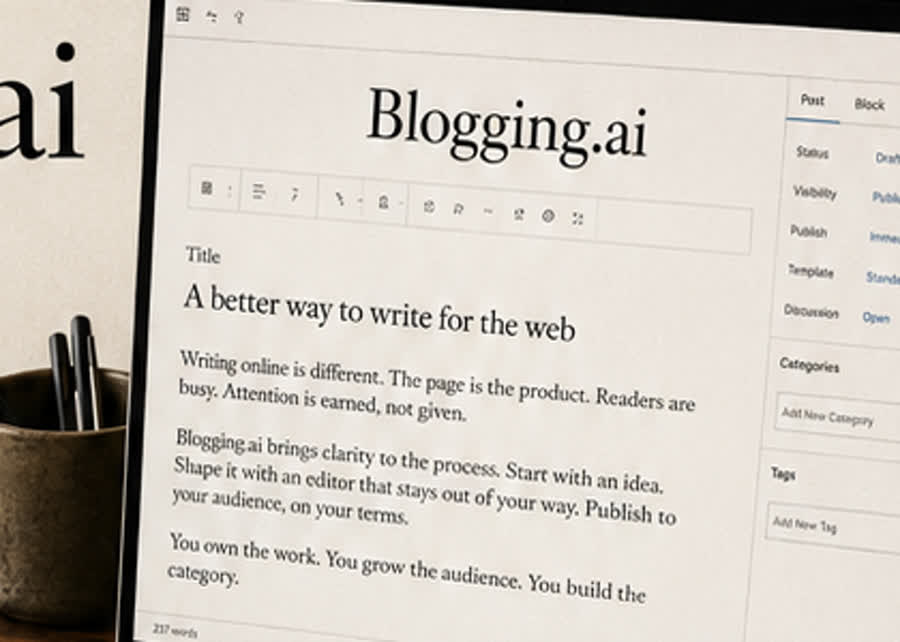
I see a blogging platform when I look at Blogging.ai because the name can sit naturally above both the editor and the public page. The opportunity is not to rebuild every content system. It is to make the central act of writing and publishing feel coherent again.
I founded i-Newswire.com in 2007 and later worked under iNewswire.com. That period taught me that a publishing interface becomes a business through repeated, ordinary use. People remember whether a draft survived, whether guidance made the work clearer, and whether the final page looked credible. I would bring that operational patience to this platform.
Start with the job
I would begin with one narrow job: give a person a quiet place to draft, publish, and maintain posts under one public identity. That sentence needs to be clear enough for a prospective customer to repeat without a tour. Blogging.ai gives the company a broad category, so the first product has to provide the focus. A strong name earns attention, but the opening experience earns the second visit.
The first useful customer is an independent writer or small expert team that has outgrown a patchwork of documents and fragile themes. I would interview people in that position before settling the workflow. The questions would stay close to actual behavior: what happened the last time a post stalled, which document held the work, who made the final decision, what had to be copied, and where quality slipped. Specific incidents reveal a product more reliably than a list of wished-for features.
I would then draw the smallest complete loop. A visitor should be able to enter with real material, do meaningful work, and leave with a result that can be used. The loop needs a visible beginning and end. Extra dashboards can wait. If the main action feels calm and obvious, the brand starts to mean something practical.
Make the standard visible
Publishing products carry an editorial opinion whether they admit it or not. Defaults shape the headline, the structure, the pace of review, and the final page. I would write those choices down as a short standard. The product should help a person make a better post, not merely move text through boxes.
The early proof would be ten customers publishing their first ten posts and returning to revise or add the next one. That evidence is more useful than a large registration number because it shows whether the product changes the work. I would watch the complete process, note where people hesitate, and remove steps that serve the interface rather than the customer. A weekly review of finished work would keep product decisions tied to output.
Trust also needs ordinary controls. Clear ownership, export, revision history, permissions, and a readable privacy explanation matter to anyone putting valuable drafts into a system. The name may sound ambitious, but the product should feel dependable in the unglamorous moments. Saving correctly and preserving a writer's intent are part of the brand.
Build distribution into the work
I would not treat distribution as a launch-day event. The product should create reasons for the right people to encounter it through useful output, thoughtful examples, and direct recommendations. A finished post, an editor's note, a public template, or a clear case can demonstrate the product without turning the customer into an advertisement.
Early outreach would stay personal. I would show the working loop to a small group, ask each person to use current material, and compare the result with their existing method. The goal is to find a repeated advantage that can be described in plain language. Once that pattern appears, landing pages and onboarding can carry the same message.
The primary constraint is the platform must make publishing simpler without taking ownership away from the writer. Naming that limit early protects the company from becoming a loose bundle of writing features. Blogging.ai can support a large company later. At the beginning, its best use is to make one important part of publishing noticeably better.
A measured first year
I would measure completed work, return use, time to a useful result, and the number of customers who would be genuinely disappointed to lose the product. Revenue matters, but these signals explain whether revenue rests on a durable habit. A small group returning for a clear reason is a better foundation than a large group that visited once.
The first year should produce a stronger operating thesis. Which customer gets the most value? Which part of the workflow deserves deeper investment? Which requests belong to another product? Answers arrive through close use, careful support, and finished work. They cannot be supplied by the domain alone.
For market context, I would keep an eye on Product Hunt, Indie Hackers, Hacker News, and Crunchbase. These sources show adjacent products, publishing practices, or company activity. They are inputs for judgment, not a checklist to copy.
The first version I imagine has a fast editor, durable URLs, a clean archive, useful author pages, simple email capture, and export that never holds the writer hostage. It would resist a marketplace and an elaborate social feed until the publishing loop was excellent.
Blogging.ai is unusually direct for that promise. The brand could welcome a first-time writer without sounding elementary and serve an established desk without sounding like a hobby. I would use that range carefully, starting with the smallest audience whose posts deserve a better home.